






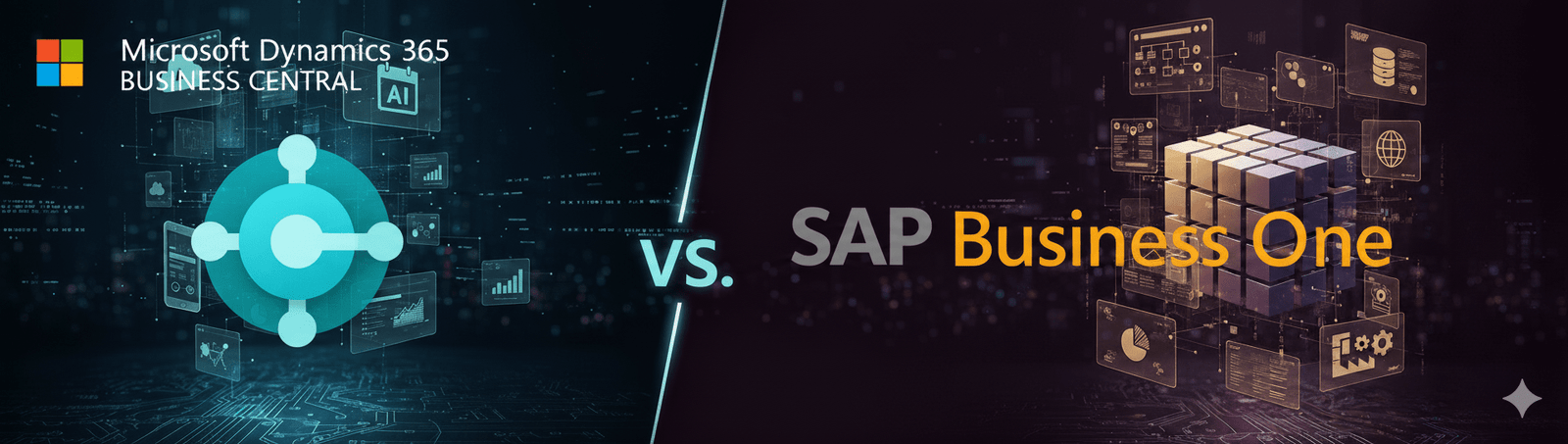
In this era of digitization, an appropriate ERP solution can serve as the linchpin between a flourishing enterprise and the one that grapples to stay afloat. With a plethora of options available, the decision-making process can be daunting. Today, we are pitting two titans of the ERP world against each other: “Dynamics 365 Business Central and SAP Business One”.
Dynamics 365 Business Central: A New Age Solution
Microsoft Dynamics 365 Business Central, formerly known as Dynamics NAV, is a cloud-centric ERP solution from the tech giant Microsoft. It places a significant emphasis on an advanced and intuitive user interface and user experience. The versatility of Dynamics 365 Business Central makes it a preferred choice for businesses of all sizes and across a broad spectrum of industries.
Dynamics 365 Business Central: Key Features and Advantages
- Productivity: Dynamics 365 Business Central offers a flexible approach to automating manufacturing operations. This not only simplifies processes but also provides a clear view of production planning and cost management.
- Integration: Dynamics 365 Business Central offers seamless integration with other Microsoft products, including Office 365, Azure, and Outlook, among others.
- Usability: Dynamics 365 Business Central provides top-tier user experience. It offers comprehensive visibility across various business functions such as customer support, distribution, sales, and marketing. Moreover, it provides real-time, quick, and accurate views of the data, enabling better decision-making.
- Licensing and Pricing: The pricing structure of Dynamics 365 Business Central is transparent and can be easily accessed on the official website. It offers three distinct licensing tiers on a per-user/month basis in its cloud mode: Team Member starting from $8 per user/month, Essentials starting from $70 per user/month, and Premium starting from $100 per user/month.
SAP Business One: A Conventional ERP Solution
SAP Business One is an ERP solution crafted by SAP SE. It offers straightforward tools, interfaces, and capabilities with a conventional appearance. SAP Business One primarily targets small and medium-sized businesses, tailoring its functionalities to cater to their specific needs.
SAP Business One: Key Features and Advantages
- Productivity: SAP Business One is proficient at managing inventory. However, it is often perceived as overly complex and not designed for future expansion.
- Integration: SAP Business One allows integration with third-party applications, although each integration may require a unique tool.
- Usability: SAP Business One offers limited human resources management capabilities and less powerful dashboard and cockpit features than Business Central.
- Licensing and Pricing: SAP Business One costs $94 USD per user per month as a subscription for a Professional License and $54 USD per user per month as a subscription for a Limited License.
In conclusion, both Dynamics 365 Business Central and SAP Business One are robust ERP solutions, each with their own strengths and weaknesses. The choice between the two depends on the specific needs and growth plans of your organization.
Drawing from this, let’s delve deeper into the topic of digital transformation and its importance in today’s business landscape.
The Imperative of Digital Transformation
In the modern business environment, digital transformation is no longer a luxury but a necessity. It’s the process of integrating digital technology into all areas of a business, fundamentally changing how you operate and deliver value to customers. It’s also a cultural change that requires organizations to continually challenge the status quo, experiment, and get comfortable with failure.
As we move forward, businesses that can effectively embark on this digital transformation journey will be the ones that thrive in the future.
SAP Business One is a comprehensive solution that covers all aspects of your business including finance, logistics / operations, and customer relationship management. Currently, over 60,000 businesses across 150 countries run SAP Business One to support their key processes. But what makes it so popular? Here are some advanced features that make SAP Business One stand out:
- Integrated Business Intelligence: SAP Business One comes with fully integrated business intelligence functionality that provides critical, real-time business information exactly when you need it. It allows you to create dashboards and reports from your business data with ease. This feature helps businesses make informed decisions based on accurate and real-time information.
- Industry-Specific Solutions: SAP Business One offers a variety of industry-specific functionalities. It’s not a one-size-fits-all solution, but rather, it can be tailored to the unique needs of your business. Whether you’re in manufacturing, retail, service, or another industry, SAP Business One can be customized to suit your specific requirements.
- Mobile Access: In today’s fast-paced business world, having access to your system anytime, anywhere is crucial. SAP Business One offers a mobile app for iOS and Android devices, allowing you to access real-time business information on the go.
- Advanced CRM: SAP Business One’s CRM functionality is not just about managing customer relationships. It also integrates with other modules to provide insights into customer behavior and value. It can help you manage the entire customer lifecycle, from first contact to final sale, to after-sales service and support.
- Document Management: With SAP Business One, you can manage documents in a highly efficient manner. It allows you to store, search, and retrieve documents quickly, which can significantly improve your business processes.
- Workflow Automation: SAP Business One allows you to automate your business processes, saving you time and reducing the risk of errors. You can set up workflows for key processes such as order-to-cash, purchase-to-pay, and cash-to-bank.
- Multi-Currency Support: If your business operates in more than one country, you’ll appreciate SAP Business One’s multi-currency support. It can handle transactions in multiple currencies and manage fluctuating exchange rates.
- Scalability: As your business grows, so does SAP Business One. It’s designed to grow with your business, accommodating new processes and functionality as needed.
- Cloud or on-premises Deployment: SAP Business One gives you the flexibility to choose between cloud or on-premises deployment. Whether you prefer to manage your IT infrastructure or let SAP handle it, there’s a solution for you.
- Integration with Other SAP Products: If you’re already using other SAP products, you can easily integrate them with SAP Business One. This provides a seamless experience and allows you to leverage your existing IT investments.
These advanced features of SAP Business One make it a powerful tool for managing your business. However, like any business software, it requires expert knowledge to fully leverage its capabilities. As a software engineer and technical writer with 15 years of experience, I can attest to the importance of proper training and support when implementing a solution like SAP Business One. With the right guidance, businesses can truly harness the power of SAP Business One and drive their growth and success.
Dynamics 365 Business Central and SAP Business One: The Future of ERP Systems
As we delve deeper into the digital age, the role of Enterprise Resource Planning (ERP) systems in business operations becomes increasingly crucial. Two of the most prominent players in the ERP market are Microsoft’s Dynamics 365 Business Central and SAP’s Business One. Both systems offer a comprehensive suite of tools designed to streamline business processes, but they each have unique features that set them apart.
- The Evolution of ERP Systems
ERP systems have come a long way since their inception. They have evolved from simple inventory management systems to comprehensive solutions that manage various aspects of business operations. Today, ERP systems are more than just software; they are strategic business tools that can drive growth, improve efficiency, and provide a competitive edge.
- Dynamics 365 Business Central: A Comprehensive Solution
Dynamics 365 Business Central is Microsoft’s cloud-first ERP solution that focuses heavily on user experience. It is preferred by businesses of all sizes across a wide variety of industries due to its intelligent ability to support a wider choice of organizational models.
One of the key strengths of Dynamics 365 Business Central is its seamless integration with other Microsoft products, such as Office 365, Azure, and Outlook. This integration allows businesses to leverage the power of Microsoft’s ecosystem, thereby enhancing productivity and efficiency.
Besides, Dynamics 365 Business Central offers flexible manufacturing operation automation, which simplifies production planning and cost management. It also provides real-time, rapid, and accurate views of data, enabling businesses to make better decisions.
- SAP Business One: Tailored for Small and Medium-Sized Businesses
SAP Business One is an ERP solution developed and designed by SAP SE. It includes simple tools, interfaces, and capabilities with a traditional look and feel. SAP B1 is primarily aimed at small and medium-sized businesses, as its functionalities are specifically designed to meet their needs.
SAP Business One is effective at managing inventory, but it is often regarded as overly complex and not built for future expansion. However, it does offer the ability to integrate with third-party apps, although each integration may require a unique tool.
A Comparative Analysis
When comparing Dynamics 365 Business Central and SAP Business One, several key differences emerge. Dynamics 365 Business Central tends to outperform in areas such as finance, human resources, and operations management. It also offers a more user-friendly interface and a more comprehensive suite of tools.
On the other hand, SAP Business One is known for its robust inventory management capabilities. However, it is often criticized for its complexity and lack of scalability.
In terms of pricing, Dynamics 365 Business Central offers a much more clear pricing model. It is licensed per user/month on three distinct tiers, making it easier for businesses to understand and manage their costs. SAP Business One, on the other hand, does not have a price transparency policy, and precise pricing information must be obtained from a partner.
The Verdict
Choosing between Dynamics 365 Business Central and SAP Business One depends on your business’s specific necessities and situations. Both systems offer robust competencies and can significantly enhance your business operations. However, Dynamics 365 Business Central’s user-friendly interface, comprehensive toolset, and transparent pricing makes it a more attractive option for many businesses.
Remember, the best ERP system is not necessarily the one with the most features or the lowest price. It’s the one that fits your business like a glove, meeting your unique needs and helping you achieve your strategic objectives.
The Future of ERP Systems
As technology continues to evolve, so will the ERP systems. We can expect to see more advanced features, better integration capabilities, and more user-friendly interfaces. As businesses continue to digitize their operations, the role of ERP systems will become even more critical.
To sum it up, the future of ERP systems like Dynamics 365 Business Central and SAP Business One is set to be shaped by several key trends, such as:
- Cloud Deployment: The shift towards cloud-based ERP solutions is becoming increasingly popular. This is due to the ease of deployment, flexibility, scalability, and cost-effectiveness that cloud solutions offer. They also allow for remote access to data, which has proven to be a significant advantage in the current era of remote work.
- Integration with Emerging Technologies: ERP systems are expected to integrate more with emerging technologies such as the Internet of Things (IoT) and Artificial Intelligence (AI). These integrations can enhance the functionality of ERP systems and provide businesses with more comprehensive and real-time insights.
- Personalization and Customization: Modern ERP systems are becoming more customizable and user-friendly. This allows businesses to tailor their ERP systems to their specific needs and preferences, improving efficiency and user experience.
- Predictive Analytics: The use of predictive analytics in ERP systems is set to increase. This involves using past business data to predict future outcomes, enabling businesses to make more informed and strategic decisions.
- Increased Use of AI: AI is expected to play a larger role in ERP systems. This could involve the use of AI for automation, improving business processes, and providing more personalized experiences.
- Industry-Specific Solutions: There is a growing trend towards industry-specific ERP solutions. These are ERP systems that are tailored to the unique needs and challenges of specific industries, providing more relevant and effective solutions.
- Two-Tier ERP: This approach involves using two separate ERP systems – one for the corporate office and another for subsidiaries and regional offices. This allows for greater flexibility and can be more cost-effective.
These trends indicate that the future of ERP systems is set to be more flexible, integrated, and intelligent. As such, businesses using Dynamics 365 Business Central and SAP Business One can expect to see these systems evolve and improve in line with these trends, offering more effective and efficient solutions for managing business operations.
Top of Form